
Search for a word or filter by target audience and topic.
How to find wedding gigs if you’re a musician or in a band
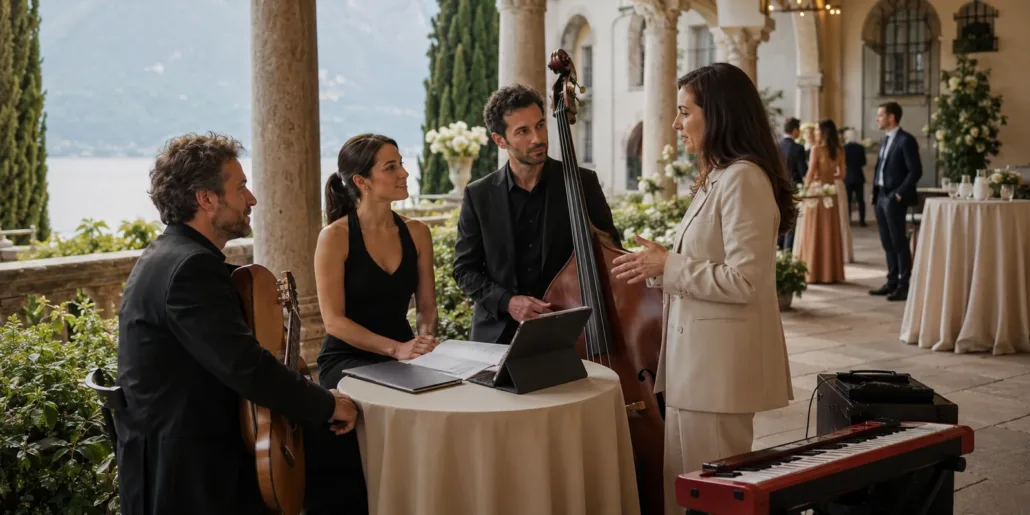
Securing wedding bookings requires more than just posting a few videos on social media and waiting for an enquiry. Brides and grooms choose musicians and DJs who they can picture as part of their big day: as they make their entrance at the ceremony, whilst guests chat over drinks, or when the dance floor needs to come alive after the cake-cutting. Musical quality remains crucial, but it alone does not allay concerns about reliability, venue space, sound systems and coordination with the venue.
A band, a duo, a singer or a DJ who are mainly used to performing in clubs and at concerts must therefore present their services from a different angle. Wedding planners are often unfamiliar with technical terms and do not know what equipment is required at different stages of the event. A clear profile translates this information into practical scenarios and helps to attract more suitable enquiries.
Why weddings are a different market from other events
At a concert, the audience is there primarily to listen. At a wedding, the music accompanies a day whose pace is constantly changing. The ceremony calls for precision; the pre-dinner drinks must allow time for conversation; the dinner alternates between service, speeches and surprises; and the after-dinner entertainment requires energy and the ability to read the room.
Sometimes the aperitif goes on a bit longer because the guests are enjoying themselves, the kitchen brings out a course early, or the cutting of the cake is delayed. An experienced entertainer does not follow the programme as a rigid schedule: they know where to cut things short, when to wait, and how to get things moving again without causing awkward silences or tension.
This flexibility should be highlighted in your profile. It’s not enough simply to write “experience in weddings”: it’s more convincing to explain that you know how to coordinate with the venue manager, photographer and wedding planner, or that you’ve already managed performances spread across the ceremony, drinks reception and the after-party.
What do couples and wedding planners really look for?
Anyone organising a wedding wants to minimise the unknowns. Phrases such as “versatile band” or “DJ for every occasion” don’t really tell you much. You need concrete answers: what line-up will be performing, which parts of the event can you cover, how much space do you take up, what equipment do you bring, and how do you manage moving between different venues?.
A wedding planner appreciates it when clients clearly specify set-up and dismantling times, technical requirements and the point of contact. The bride and groom focus mainly on the atmosphere, the set list and the video, but a well-organised information sheet also reassures them about the practical details.
Imagine a villa with a ceremony in the garden, drinks in the courtyard and a party in an indoor hall. Stating that you have a compact setup for the ceremony and a second venue for the party makes it immediately clear whether the proposal is suitable. It also avoids a long series of messages only to discover, once negotiations have begun, that the travel time required is incompatible with the schedule.
Repertoire, videos and live performances: what to show
The repertoire should serve as a guide, not aim to impress with its sheer volume. An endless list of titles is rarely read through. It is more useful to divide the pieces into categories such as the ceremony, pre-dinner drinks, dinner and the party, indicating the main styles and giving a few representative examples.
Videos carry even more weight, provided they capture the event as it really is. Footage shot at a wedding – even if it’s less polished than a showreel – showcases the audience, the setting, the perceived energy levels and the ability to command the scene. The bride and groom want to see what happens when the dance floor is initially quiet, when guests are singing, or when a band is playing without drowning out conversations.
A studio video is still useful for assessing vocal ability and musical quality, but it shouldn’t be the only evidence available. You should also avoid clips consisting solely of lighting, mixing desks, close-ups of instruments and just a few seconds of performance.
Reviews paint a more complete picture when they mention specific examples: punctuality, helpfulness in the run-up to the event, how changes were handled, or the ability to engage guests of different ages. Asking for feedback shortly after the wedding, whilst memories are still fresh, encourages more spontaneous testimonials.
How to describe our training, style and services
The line-up must be clear within a few seconds: solo artist, duo, trio, full band or a DJ with live musicians. If you offer multiple set-ups, explain what occasions they are designed for. An acoustic duo for the pre-dinner drinks and a full band for the party are two distinct services, not a generic promise of flexibility.
The style, too, should be described in terms of recognisable scenarios. “Italian and international pop for singing and dancing” or “jazz, swing and bossa nova for aperitifs and dinner” conveys more than simply “a comprehensive repertoire”. Stating what you don’t do can be just as useful: no microphone banter, no disco-style set list, or a service focused on background music.
Please specify what the proposal includes: sound system, lighting, microphones for speeches, background music during breaks and the duration of the service. If the venue’s equipment needs to be checked before confirming its use, please state this. The client needs to understand what they are comparing when they receive different quotes.
How to respond to a request without losing track of it
The first reply can determine whether the contact goes any further. A generic message sent after a long delay gives the upper hand to whoever replies first and best. There’s no need to draw up a full quote straight away: simply confirm your availability, or say that you’re checking it, and summarise the date, venue and service required.
Then ask a few specific questions. Ceremony, drinks reception, dinner or party? How many guests are expected? Are the venues indoors, outdoors or separate? Does the venue have a sound system that can be tested? Specific questions show you’re paying attention and help you avoid a proposal based on assumptions.
Where appropriate, present two options. For example, DJ sets only after dinner, or live music during the aperitif followed by a DJ for the party; an acoustic duo or a full band. The options must be genuinely different and should explain what’s included, the duration and any technical requirements; they should not simply be two figures without any context.
How to use Lyrium to find wedding bookings
On Lyrium, a profile works when it helps the client make a choice, not when it merely confirms that the artist exists. The title, description, photos and videos must clearly relate to weddings. If you also work for businesses, venues and private parties, keep these areas separate and give prominence to images that genuinely show receptions, ceremonies and guests.
Please specify the counties and areas where you usually work, without extending your reach beyond what you can manage within a reasonable budget and timeframe. Please keep your training, portfolio, equipment and available set-ups up to date. A photograph taken at a wedding often conveys more than a studio shot, as it shows the attire, the setting and your rapport with the guests.
You can start from the Creating the profile on Lyrium and refine your texts, videos and reviews over time. Then take a look at the enquiries you’ve received: if most of them are for unsuitable events, your profile probably doesn’t make your style, service or geographical area clear enough. The aim isn’t to secure just any booking, but to find wedding bookings where your offering can really shine right from the very first agreement.