
Search for a word or filter by target audience and topic.
Wedding entertainment: ideas for keeping guests engaged without going over the top
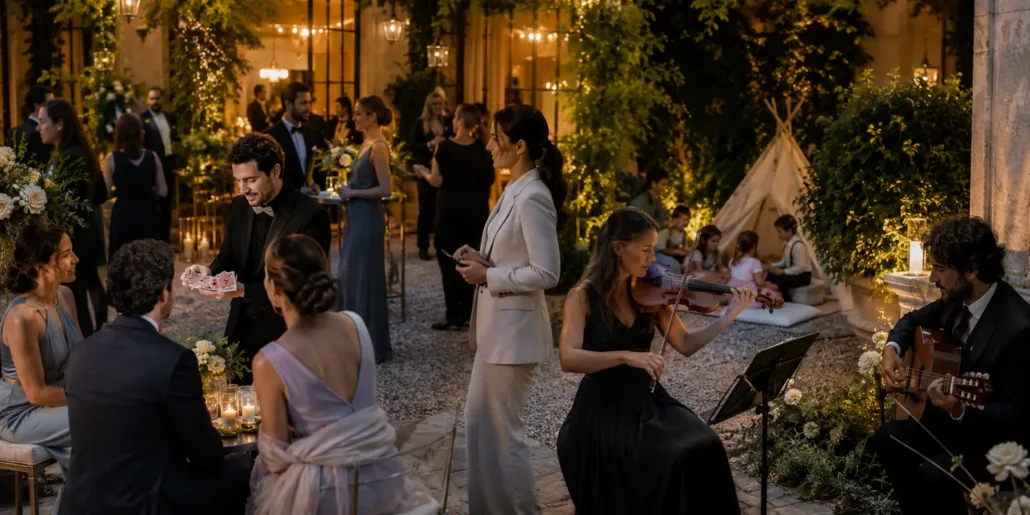
Good wedding entertainment complements the day without taking over. There’s no need to fill every gap or turn the guests into reluctant stars. Before choosing music, magic, entertainment or a show, consider the guests’ ages, any children present, the venue layout and the kitchen’s timetable. The key question isn’t how many activities to include, but where entertainment is really needed and to what extent. Often, all you need is some well-chosen background music, a highlight of the day and a livelier segment after the cake.
Entertaining doesn’t mean keeping people occupied every minute
A wedding consists of different stages. Whilst waiting for the bride and groom, or as they make their way to the reception hall, guests may need something to keep them occupied. At the table, they want to chat, eat and catch up with people they haven’t seen for a long time. If every gap is filled with a game, an announcement or a performance, the day loses its sense of flow.
Elegant wedding entertainment often works by a process of subtraction. Music can accompany the pre-dinner drinks without constantly drawing attention to itself; a short performance can be slotted in during the dinner; and the most interactive part can take place when guests are free to move about.
For each suggestion, ask yourselves what purpose it serves: does it complement the event, draw attention to it, or directly engage the guests? If two activities fulfil the same need, one is likely to be superfluous. Even a break can be useful for the catering, the photographer and allowing guests to move around.
Aperitif, dinner and cake afterwards: what works at each stage
During the aperitif, entertainment that allows for conversation is ideal. A musical duo or trio, a roaming performer or a magician working with small groups can entertain guests as they arrive without forcing everyone to look in the same direction. Do bear in mind the space requirements, however: a band positioned next to the buffet will get in the way of service, whilst a roaming performance requires clear pathways.
Greater precision is required during dinner. Short speeches work well between courses, provided they are coordinated with the head waiter. A surprise from friends just as the hot dishes are being served can hold up the waiters and divide their attention: the idea may be a good one, but the timing is wrong.
Once the cake has been served, there’s more scope for dance music, performances and wedding entertainment. If many of the older guests are likely to leave the party early, a segment suitable for all age groups could be scheduled earlier, whilst saving the liveliest part for those who stay on to dance.
When children’s entertainment really makes a party special
Children’s entertainment at weddings is useful when there are quite a few children, their ages are fairly similar, and the venue offers a suitable space. A table with a few games is not the same as an organised service. The venue, duration, age groups to be looked after, and arrangements for meals and transport must all be clarified.
For very young children, parents are often present. For older children, workshops, guided games or a short show may be suitable. If the group includes both three-year-olds and children approaching adolescence, ask the activity leader how they will organise the activities.
The location matters too. A children’s area next to the live music or the speech area can easily cause disruption. The aim is not to separate the children from the adults for the entire reception, but to provide suitable activities and give parents a few quieter moments.
Magician, comedian, performer or live musician: selection criteria
Every performer has different requirements. A wedding magician may work at the tables, engaging a few guests at a time, or put on a show facing the audience. In the first case, freedom of movement is required; in the second, visibility, the audience’s collective attention and sufficient space are needed.
A comedian needs an audience that is willing to listen and to stop and watch. The tone should be chosen with the guests’ sensibilities in mind: personal jokes or an aggressive style of hosting can make those who do not like to put themselves in the spotlight feel uncomfortable. A visual performer can work well as the main act, but the ceiling height of the venue, safety, space requirements and weather conditions must all be taken into account.
Live music at a wedding provides continuity, provided that the line-up, repertoire and volume are suited to the occasion. An acoustic duo playing during the aperitif serves a different purpose to a band playing on the dance floor. To help you decide, you can explore the different types of artists and services starting with the role: to accompany and entertain small groups, to create a shared experience or to get the ball rolling.
Avoiding awkward moments, overlaps and downtime
Not all guests want to be called up to the microphone, go on stage or take part in a game. If you choose an interactive activity, ask the performer how they involve the audience and whether they respect those who prefer to stay in their seats. Voluntary participation creates a more natural atmosphere than any amount of persuasion.
Overlaps often occur because each supplier is only aware of their own part of the plan. The DJ prepares the musical intro, friends organise a video, the photographer takes the bride and groom out into the garden, and the kitchen waits to serve. You need a point of contact to set priorities and give the go-ahead.
The schedule can remain flexible, but it must set out the key elements. Speeches, the serving of food, photography and performances cannot all begin as soon as a few minutes become available. For outdoor activities, you should also prepare an alternative plan: available space, movement of the audience and the possibility of relocating the equipment.
Writing a clear brief for artists and suppliers
Before contacting the wedding artists and professionals, gather the information relevant to the proposal: date, venue, approximate number of guests, whether children will be attending, the stages to be covered, available space and the desired level of participation. Note any venue restrictions regarding timings, noise levels, access and outdoor areas.
You don’t need to have every detail sorted out in advance. It’s more useful to explain the problem: to provide entertainment during a long aperitif, to keep the children occupied during dinner, to create a brief moment of togetherness, or to get the dancing started without an overbearing host. A professional can only suggest a suitable solution if they know the objective, not in response to a vague request such as “we’d like a bit of entertainment’.
Ask about the actual duration, set-up times, space required, equipment included, how to get involved, and coordination with the kitchen, venue and other suppliers. With a clear brief, you can compare the available profiles considering not the most eye-catching proposal, but the one that will fit in with your wedding without disrupting its flow or putting your guests under pressure.