
Search for a word or filter by target audience and topic.
Sound, lighting and event hire services: how to convey reliability
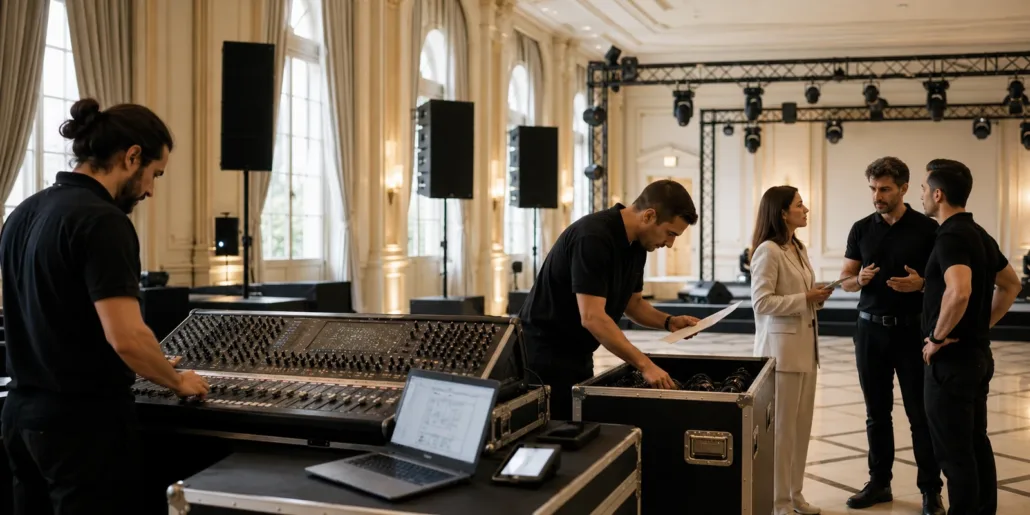
Understanding how to promote a sound and lighting service means looking beyond a mere list of available speakers, mixing desks and spotlights. These details are of interest to sound engineers and musicians, but event organisers are primarily concerned with whether the set-up will be suitable, whether it will be installed on schedule, and who will step in if the programme changes.
Technical expertise must therefore be presented in a way that is easy to understand. A photograph of a warehouse and a long list of models do not explain how you work at a wedding, a conference or a concert in a villa. The information sheet should make it clear which events you organise, what each package includes and which tasks are the client’s responsibility.
With a service, the customer buys continuity and control
Anyone looking for an audio-visual service for events isn’t just buying equipment. They’re buying the assurance that music, speeches, videos and official proceedings will go ahead without any interruptions caused by inadequate preparation. This is the value that needs to be communicated before the technical specifications.
Describe the work process in simple terms: gathering information, a site visit if necessary, defining the project, assembly, testing, support and dismantling. The client needs to understand when you come into the picture, what checks you carry out and what you will personally oversee.
If you offer different packages, make sure to distinguish them clearly. With dry hire, the equipment is collected or delivered and is then left for the client to set up and manage. Delivery with installation includes the initial set-up, but does not necessarily include on-site support during the event. The supported service, on the other hand, provides for one or more technicians to be present whilst the event is taking place.
These differences have a greater impact than the brand of a loudspeaker. An inexperienced client might think that simply plugging in a few cables is enough; your presentation must explain when design, testing and technical supervision are required.
Showcase real projects, not just a list of brands
The list of equipment remains useful, particularly when the profile is read by artists, agencies or technical managers. However, it should not take centre stage in the communication. A client gains a better understanding of the service by looking at situations similar to the one they are organising.
Select a few projects and describe them in simple terms. A corporate dinner might have required microphones for the awards ceremony, even sound coverage and subtle lighting. A concert in a villa may have involved multiple sound positions, a power supply located some distance from the stage, and coordination with a large band. An outdoor ceremony may have required clear sound even in the back rows.
The photographs should show the production in its setting: the stage, the control room, the cable runs, the lighting layout and the relationship with the audience. An overall view conveys more than a series of close-ups of equipment. In the videos, where possible, ensure that the dialogue is clear and that the actual effect of the lighting is evident.
Brands and models can be added later. First, you need to explain what problem was solved and why that configuration was suitable for the event.
Site survey, sizing, lighting and backup systems
A site visit proves its worth when it reveals details that an email enquiry simply cannot convey. A venue may claim to offer easy access to the stage, but on arrival you might discover a narrow staircase, a long stretch where equipment cannot be unloaded, and a control room situated right in the catering route. Without a site inspection, the set-up and the programme schedule are already off to a rocky start.
In the information sheet, explain when you recommend a site visit and what you check: access points, spaces, available power supply, the location of the stage and control room, cable routes, coverings, set-up times and compatibility with other suppliers.
Avoid presenting power figures as one-size-fits-all solutions. The scale of the system depends on the venue, the audience, the intended use, the acoustics and the venue’s constraints. It is more credible to explain that the configuration is tailored to the actual context.
Backup arrangements should also be communicated in concrete terms, without promising that no failures will ever occur. Specify which critical components are monitored and how you organise any replacements or redundancies. For structures, power supplies, suspensions and installations subject to specific requirements, make it clear that feasibility is assessed on the basis of the location and applicable conditions.
Liaise with artists, venue staff and the event manager
An effective service does not operate in isolation. It must be aware of the artists’ requirements, the venue’s timetable, the catering arrangements and the name of the person authorised to make decisions during the event.
Explain how you manage this coordination. From the artists, you need technical specifications, instruments, microphones, backing tracks, monitors and rehearsal slots. With the venue, you need to clarify access, power supply, operational restrictions, available spaces and times. With the organiser, you need to finalise the running order, priorities and the on-site contact person.
One common scenario involves unscheduled speeches. A guest stands up from a table at the far end of the room, the microphone isn’t ready, and the whole room is waiting. You can’t foresee every eventuality, but you can ask in advance who will be speaking, from where, and at what points in the programme.
For assignments between Italy and Ticino, it is helpful to specify the area covered, the currency of the quotation, travel times and the languages that can be used for technical communications. These are simple details, but they help to avoid misunderstandings even before the site visit.
How to write a clear technical quotation
A quote for sound services must be understandable even to those unfamiliar with technical abbreviations and equipment. Organise the items by function: sound reinforcement for the audience, artist monitoring, microphones, lighting, control room, transport, set-up, support and dismantling.
State what is included and what is excluded. For hire-only arrangements, specify who will collect, install, use and return the equipment. If support is provided, clarify the times and the services covered. Where the price depends on a site visit or a technical specification that is still pending, state this before confirmation.
You can include a detailed section for musicians and sound engineers, but the main body of the text must remain easy to read. “Two wireless microphones for the presenter and guest” is more useful than a list of codes that doesn’t explain what the equipment is used for.
Please also include any conditions that may affect the service: extensions, additional requests made after confirmation, a change of venue, a second workstation or changes to the set-up times. Being clear from the outset prevents every change from being discussed at the most inopportune moment.
Building a board on Lyrium that exudes reliability
The fact sheet should immediately distinguish between audio service with support, Event hire e sound system and accessories hire. If you offer several solutions, describe them separately, specifying the target audience and level of support.
Start with the events you usually organise, then showcase the process, real-life examples, the workspace and key equipment. The images should illustrate the layout and proportions of the set-ups. The most convincing reviews highlight punctuality, coordination, the ability to deal with the unexpected and the clarity of the quote.
You can update your attendance from Access for Artists and Professionals or explore the options available in the Lyrium Membership page. Before publishing, however, do read through the listing again as a non-technical customer would: they need to understand what you’re offering, what support they’ll receive and who will actually be organising the event.