Amélie & Alex
PIANO AND FEMALE VOICE
The best live music, full of joy and class
Over 500 high-quality events, always organised with elegance and professionalism
from €400 to €1,800
Specific request for private ceremonies
I musicians for private ceremonies they serve when the ritual needs a live presence, but not necessarily a protagonist voice or a solemn formation. Pianist, guitarist, harp, acoustic duo, voice and piano, small ensemble or light instruments can make a civil riteThe choice must be made on the type of listening: intimate, collected, elegant, spiritual, contemporary or family, especially when the guests are few and close. They include repertoire, volume, position, technical autonomy and ability to follow times not always rigid. The right musician does not fill the ceremony: he makes her breathe naturally.
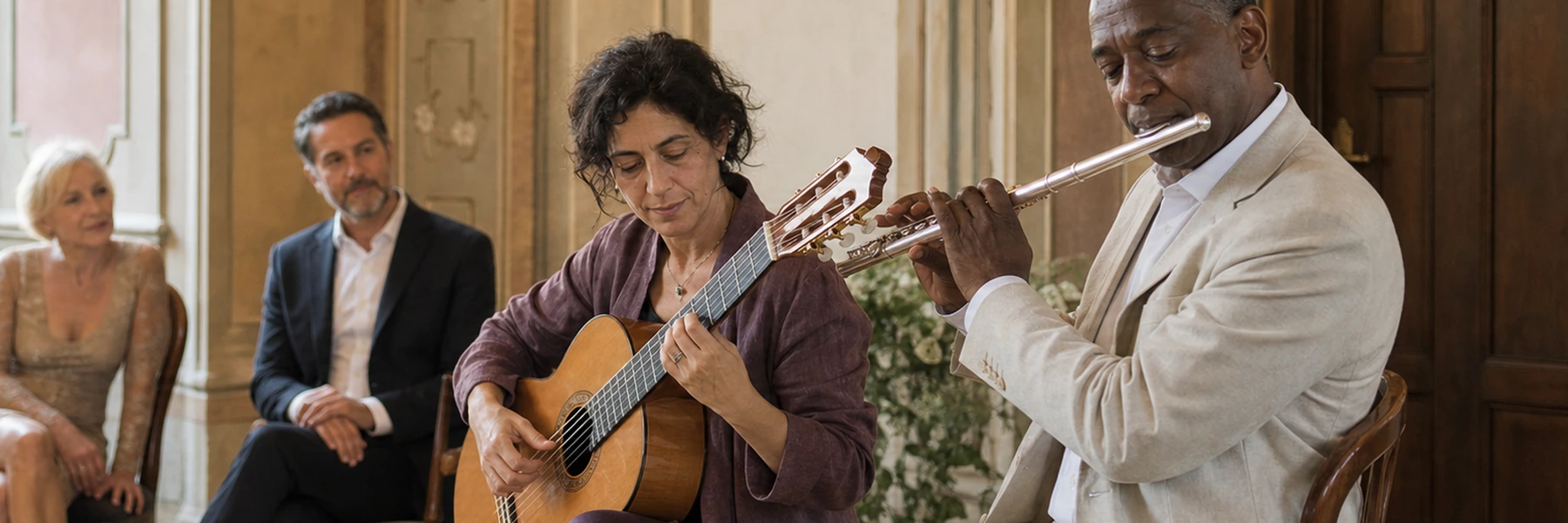
I musicians for private ceremonies They are suitable when you want a human sound, flexible and close to the guests. A pianist can give elegance and depth, a guitarist creates intimacy, an acoustic duo accompanies well input and output, a small ensemble supports larger spaces. Before choosing, define whether the music must be the protagonist or frame. In private ceremonies often wins the second way: accompany without invading, light a passage and then let talk ritual, people and silences, with a presence that seems necessary.
The pianist for private ceremony It requires a good instrument, a quality keyboard or rental; the guitarist is more agile, but it needs to be evaluated on repertoire and amplification; the voice and instrument duo gives warmth, while an ensemble offers more body. Do not choose only for taste: consider accesses, current, space, seats, acoustics, wind, distance and visibility. A small formula can be more elegant than a wide training if the place is collected and if the guests are close.
The live music for civil rite or symbolic must follow clear signals. Entry, readings, signatures, symbolic gesture and output have variable durations; an experienced musician knows how to shorten, close or resume without making visible the adaptation. Ask how he manages expectations, delays, spoken interventions and unplanned passages. Flexibility is an advantage of live music, but it works only if celebrating, referent of the venue and artist know who guides every moment.
In the quote for private ceremony musicians must be clear training, duration, repertoire, songs on request, instruments, system, microphones, seats, laws, current, arrival times, audio testing, travel, transfers, food and accommodation if necessary, extra hours and emergency plan in case of rain. If you need piano, keyboard weighed or second point music, you should indicate immediately. The best estimate explains not only what will be played, but how will be made reliable.
Piano, guitar or acoustic duo are suitable when you want warm and non-scenographic presence.
Live music follows better expectations, inputs and breaks if the signals are clear.
Small ensembles give life to the ritual without turning it into concert.
It depends on the tone: piano for elegance, guitar for intimacy, duo for warmth, ensemble for greater presence. It is especially important the relationship between space, guests and passages of the ritual.
Only if available and in good condition. In many cases a professional weighted keyboard is safer, provided it has credible sound, proper amplification and proper position.
Better to accompany before or after, not under important words. If you need a light carpet for a symbolic gesture, you should try and keep it very discreet.
Yes, if the songs are few and well cut. In a short ritual, precision counts more than the amount: input, signature or output can suffice.
A contact person is needed to give clear signals. Musicians need to know if they can extend, shorten or resume a song without creating embarrassment.
It depends on instrument, place and number of guests. In the outside often yes; in the interior it is necessary to evaluate acoustics and reverb. The objective is to make the sound readable, not strong.
Date, place, time, type of rite, number of guests, musical moments, desired instruments, possible external, current, repertoire and services already present.
Training, duration, repertoire, instruments, installation, audio testing, sessions, leggings, travel, extra, second point music and emergency plan in case of rain.