Amélie & Alex
PIANO AND FEMALE VOICE
The best live music, full of joy and class
Over 500 high-quality events, always organised with elegance and professionalism
from €400 to €1,800
Guide for private ceremonies
The music for private ceremonies must not fill the ceremony: it must give it breath, order and memory. civil riteIn a symbolic ceremony, in a renewal of promises or at a solemn family moment, few well chosen interventions are worth more than a long setlist. singer, Violin, string quartet, pianist, acoustic duo or small ensemble produce very different presences: voice and word, instrumental elegance, intimacy, solemnity, lightness. The right choice comes from the place, people, tone and passages really important, including silences, looks and breaks that should not be forced. The best music does not cover emotion: it accompanies it until it becomes shared memory.
The music for private ceremonies It works when each entry has a reason. Arrival guests, entrance of the person or couple, readings, symbolic gesture, promises, signatures, dedication and exit do not ask for the same intensity. In some passages only a light carpet is needed; in others a voice or an instrumental theme can become the heart of the ritual. Before choosing the artist, define what moments must be supported by music and which instead must remain silent, because in the ceremonies collected the excess is felt immediately.
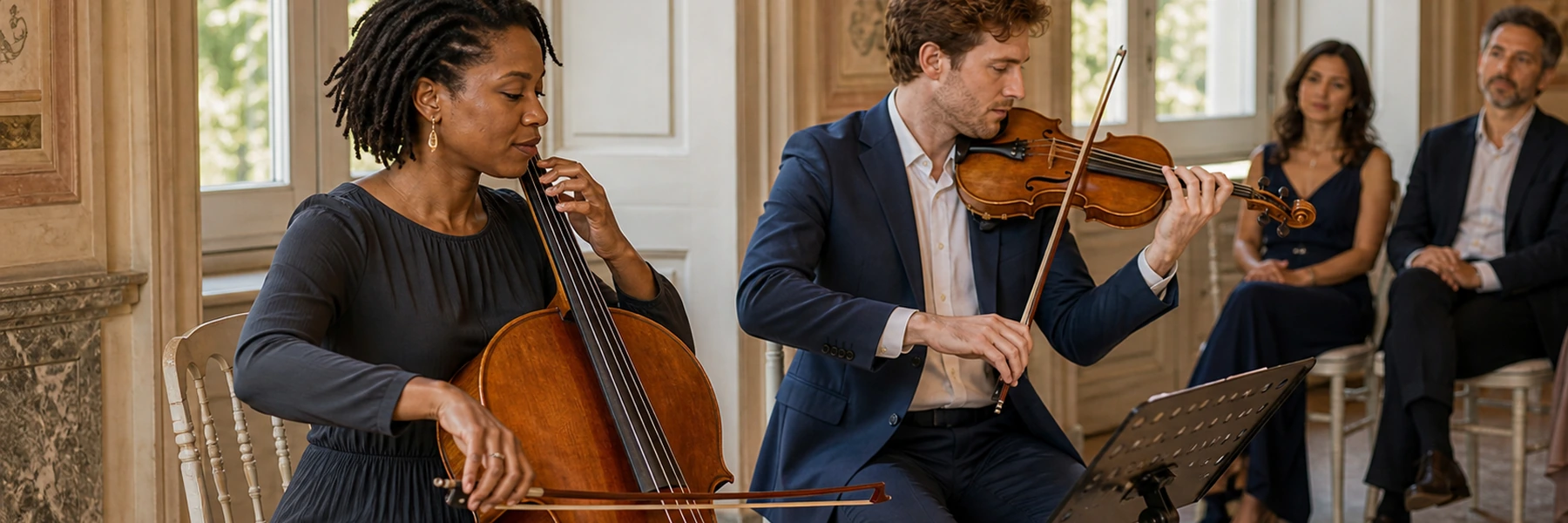
A singer for private ceremonies brings word, text and human intensity; Violin and the strings give elegance, continuity and a more discreet presence; piano, guitar, harp or acoustic duo can make the ritual more intimate. There is no better training in absolute: the acoustics of the place, the number of guests, the distance from the sessions, the duration of the ritual and the familiar sensibility. Ask for live video in similar contexts, available repertoire and ability to adapt tonalities, time and volume at the moment.
In the civil rite The timing can be more dry, so the music must enter accurately without unnecessary lengthening. symbolic rite There is more freedom, but for this very reason a trace is needed: who speaks, when music starts, how long a reading lasts, where musicians and celebrants are staying, who gives the signal. Avoids too long passages during words and clarify if the artist can accompany a symbolic gesture without covering the voice. A private ceremony lives of balance between sound, word and silence.
In the budget for the music of a private ceremony must be clear training, repertoire, duration, number of interventions, songs on request, arrival, audio test, sessions, readings, microphones, amplification, current, transfer, food and accommodation if necessary, extra hours and emergency plan in case of rain. Ask who coordinates with celebrant, venue, photographer, videomaker and audio service. Music seems natural only when signals, volumes and times have already been decided.
It needs a recognizable piece, proportionate to space and capable of starting without excessive emphasis.
Music can accompany pauses and symbolic gestures, but it must never cover important words.
It is the moment when the ceremony can open: tone, rhythm and duration must be chosen in advance.
Usually, a few well chosen moments are enough: entrance, possible reading or symbolic gesture, signatures or dedication, output. Adding too many pieces can make the ceremony longer without making it more intense.
It depends on the tone. The singer gives centrality to the text and can be very exciting; instrumental music is often more discreet and suitable when the words of the ritual must remain the protagonists.
Yes. The civil rite often has more rigid times; the symbolic rite allows more personalization. In both cases a clear running order is needed to avoid expectations, overlaps and too long passages.
In the outside almost always, also for acoustic instruments and voice. In the interior depends on acoustics, distance and number of guests. It must be decided first, because microphones and diffusion change quality and understanding.
Yes, but they must be communicated in advance. The artist must verify arrangement, hue, text, duration and compatibility with the ritual. A beloved song may not work if it enters the wrong moment.
They must be as visible as they are, but not block passages, photos, celebrant or guests. It also counts the distance from the speakers, the light, the shadow, the wind and the possibility of reading sheet music or tablet.
It must be established first. It can be a celebrant, planner, venue contact person or musician himself. Without a clear signal, the entrance or exit risk to leave late or uncertainly.
Training, duration, number of interventions, repertoire, extra tracks, audio testing, amplification, sessions, leggings, transfer, possible food and accommodation, extra hours and emergency plan in case of rain.