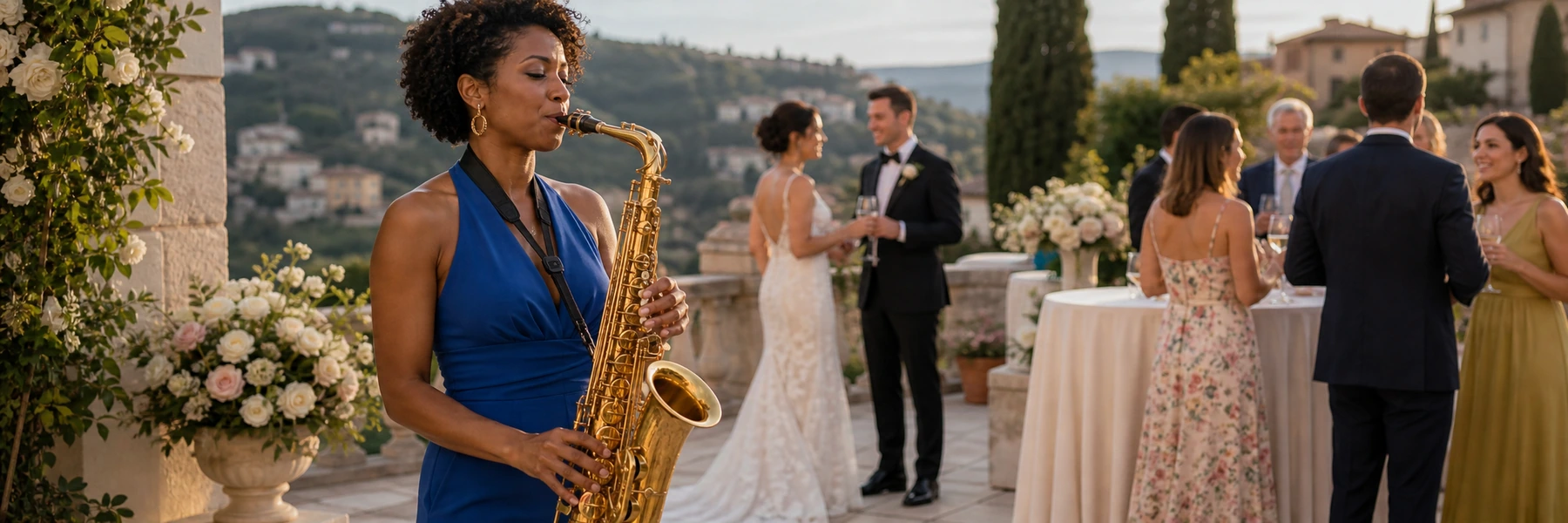
A saxophonist for wedding brings a different light: the sax enter theCocktail hour with contemporary elegance, lights the cake cutting, makes the reception and, together with DJ set, can transform the party in a physical, visible, contagious moment. It can also work in civil rite, in an entrance or in a first dance, if the tone remains consistent with the couple and the venue. But just because the sax is noticed, it is well designed: repertoire, volume, bases, wireless microphone, position, duration of interventions and relationship with guests change everything. The right sax doesn't sound over the party: it crosses it at the exact point where a thrill is needed.
Wedding saxophone player: contemporary elegance, no scenic noise
The saxophonist for wedding works when you want a recognizable sound, warm and modern, able to cross jazz, pop, soul, lounge, house and great Italian classics. wedding sax may accompany theCocktail hour, ignite the cake cutting, create an elegant passage during the reception or enter the party together with the DJ. Its strength is also its risk: if volume, bases and stage presence are not measured, the saxophone player can become intrusive. The good saxophonist knows when to be noticed and when to stay inside the atmosphere. The choice must be linked to the sequence of the day: ceremony, aperitif, dinner, cake cutting and party require different intensity, duration and scenic presence.
Sax for wedding aperitif: atmosphere, conversation and guest flow
The wedding cocktail saxophone It is suitable when you want an elegant but live welcome, more photographic than a simple background and lighter than a band. It must support greetings, toasts, photographs and catering service without covering the voices. In the garden you need wind alert, sound dispersion and speaker position; in small rooms you have to avoid a too strong effect. Repertoire lounge, jazz, bossa, slow soul, acoustic pop or soft deep house works if it is ordered by intensity, not played all the same. Always listen to live evidence or credible recordings, because repertoire, pause management and reading ability of guests of different ages are worth more than a list of very long tracks.
DJ sax for wedding: live energy without breaking the dance floor
The formula DJ Sax for wedding is effective when you want musical continuity and a live element that makes the energy rise. The saxophonist can intervene on house, dance, revival, funk, Latin, pop and songs chosen by the spouses, moving between consoles and track. Before confirming, clarify if he works with a specific DJ or with any DJ, if he uses wireless microphone, own bases, monitor, bright sax or scenic effects. Interventions must be dosed: few well built inputs are worth more than a continuous sax over each song. In the quote ask for actual lineup, system, microphones, lights, assembly times, extra hours and coordination with venue, catering, photographer or wedding planner.
Quote for wedding saxophonist: repertoire, technique and limits of the venue
In the quote for a wedding saxophonist must be clear duration, covered moments, repertoire, songs on request, bases, audio system, wireless microphone, possible luminous sax, tests, arrival, movements and coordination with DJ or wedding planner. Ask how are managed volume, acoustic limits, current, outdoor spaces, emergency plan in case of rain, SIAE if relevant, transfer, food and accommodation and extra hours. A precise quote avoids the most frequent confusion: thinking that you have chosen "sax for everything" when in reality only a short intervention is provided. If wedding saxophonist does not solve every moment, evaluate a combination with soloists, DJ, ensemble or technical support: often the best solution comes from different and well coordinated roles.