The Sign of Jazz
MUSICAL ENSEMBLES FOR EVENTS
Jazz-inspired elegance for bespoke events
Since 2011, he has been booking artists and bands for weddings, festivals and clubs.
from €360 to €1,500
Guide for venues, clubs and restaurants
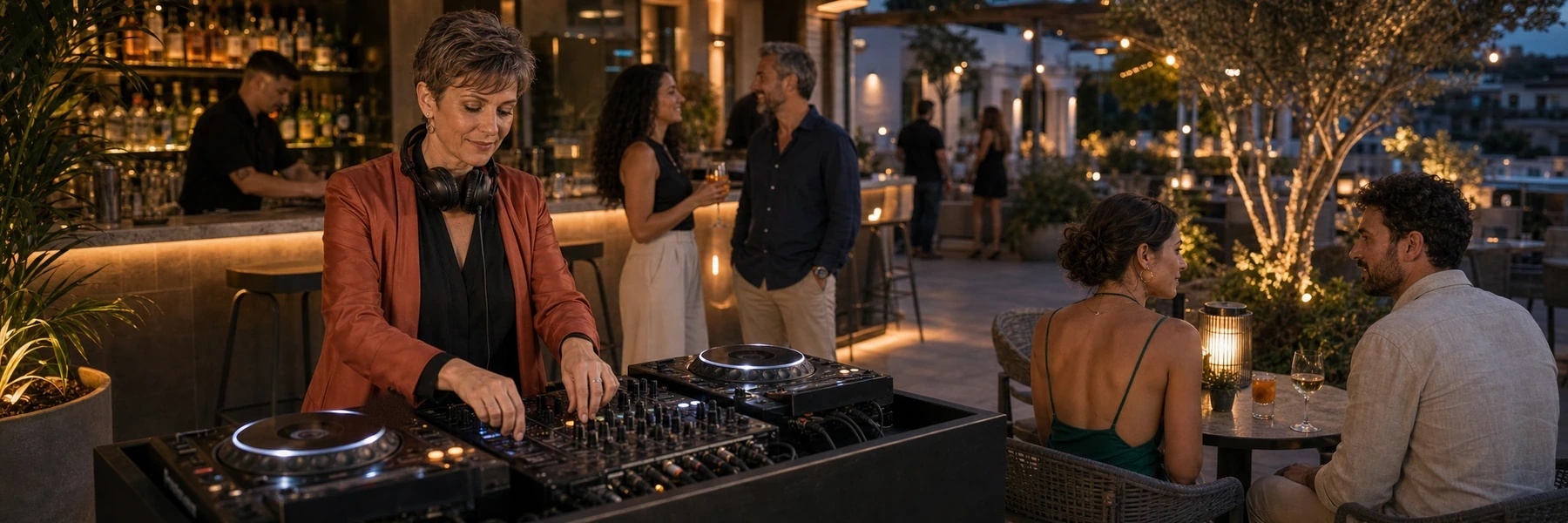
The DJ nights for clubs they work when the music becomes an identity choice, not an added noise to the room. In a Club, in an evening bar, in a restaurant with aperitif or in a space with mixed clientele, the DJ must understand public, time, consumption, volume, staff and time of the week. A well-built running order can keep people longer; a wrong selection can empty tables, disturb those who dinner or create a promise different from that of the local. The evening must remain sustainable also for collection and service. The right DJ does not occupy the evening: the orient, makes her breathe and makes her recognizable.
A DJ night for a club It must have a precise reason: after dinner, club, inauguration, weekly appointment, theme night or revival of a weak time slot. Before choosing the DJ, define the desired audience, the usual one, the day of the week, the duration and the economic goal. A Thursday listening is not designed as a Saturday dance; a restaurant does not have to become a club. Programming works when the client understands what he finds and why he comes back.
A DJ for a club works on the dance floor, on the progression and on the estate of the public; a DJ for a bar must give energy without burning too soon the evening; a DJ for a restaurant It must protect conversation, dinner and service, perhaps raising pace only after a certain hour. Ask for experience in similar contexts, not only musical genres. Bravura is not measured by the volume or visible technique, but by the ability to understand when to push, when to accompany and when to leave room to the local.
In DJ nights for clubs, the playlist must be flexible but not random. You need tracks suitable for the identity of the place, clean transitions, microphone used in moderationment, audience requests filtered and attention to service moments. If new tables enter, if the kitchen slows down, if the counter is filled or if the room is empty, the DJ must notice. Ask how it handles passages, breaks, any ads, requests, improvised birthdays and energy change. The music must read the place, not control it.
In the budget for a DJ evening in a club must be clear duration, time, arrival, preparation, consoles, audio system, microphone, any lights, running order, genres, promotional material, transfers, music permissions, volume limits, maximum time, extra hours and technical responsibility. Ask if the DJ uses the plant of the premises or brings its own, who controls the volume, who speaks with the staff and how it manages an evening that goes better or worse than expected. Continuity comes from practical agreements, not from the initial enthusiasm.

When you want recognizable atmosphere, soft pace and stay without disturbing conversations and service.
When the dance floor, musical progression and the public estate are the center of the evening.
When you want a recurring appointment with clear sound identity and easy to promote communication.
In the club the DJ works mainly on the dance floor and progression; in the restaurant it must protect dinner, conversation and service. They change volume, repertoire, timing and way of reading the audience.
Watch the public, capacity, timetable, average spending, neighborhood, identity of the place and goal of the evening. If music does not support the commercial experience, it risks being just disturbing.
Depends on the room. Some have fixed system, others require speakers, consoles, microphones and lights. It needs to be clarified first, because it changes price, quality, assembly times and responsibility.
Very. Too low makes the evening weak; too high it lets out those who want to talk, complicates the service and can create problems with neighborhood or acoustic limits. The volume must follow schedule and audience.
It takes orientation, not a cage. It is useful to define genres, tracks to avoid, desired energy and identity of the room, leaving the DJ margin to read the room.
It can provide materials, name of the evening, poster, social content or musical indications, but it must be agreed. For recurring evenings communication must be consistent with the local calendar.
The DJ must filter requests and dedications according to the tone of the evening, age, energy and limits of the local. Accepting everything can break identity and rhythm.
Duration, time, arrival, consoles, system, microphone, lights, running order, genres, promotion, transfers, permits, volume, extra beyond time and technical responsibility.