
Search for a word or filter by target audience and topic.
Children’s entertainment for events: when it’s needed and how to choose it
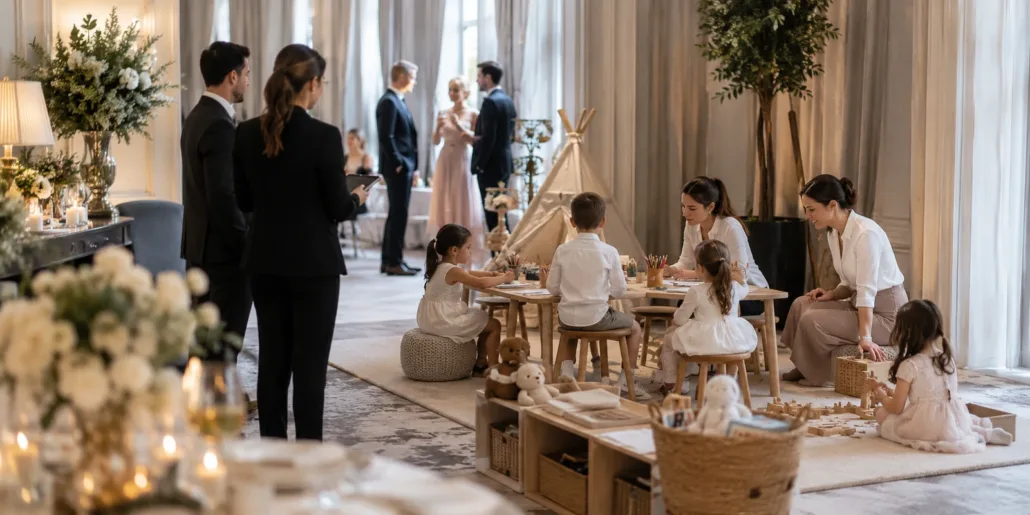
Children’s entertainment for events works best when it is based on the actual characteristics of the group, rather than on the number of activities included in the package. Age, number of participants, duration and available space matter more than a long list of games. A programme suitable for a two-hour birthday party may prove too scattered for a wedding; similarly, a quiet workshop may not work well at a corporate event with staggered arrivals and children who do not know one another.
Before comparing entertainers, magic shows, face painting or inflatables, clarify who will be attending, for how long and what level of adult supervision will be required. This helps you choose a service that is appropriate for the occasion and avoids misunderstandings regarding supervision, materials and liability. The aim is not to fill every minute, but to create activities suitable for children without complicating the overall programme.
When entertainment really enhances the experience for adults
Entertainment is particularly useful when the schedules of adults and children start to diverge. At a wedding, for example, young children can easily follow the ceremony and drinks reception, but may lose focus during a long dinner. At a corporate event, on the other hand, the entertainment can accompany a presentation, a lunch or a networking session aimed at parents.
There’s no need to cover the whole day. It often works best to focus the service on the most delicate moments: the wait before a meal, breaks between courses, speeches, photographs or formal occasions. A non-stop programme lasting several hours is likely to tire the children out and leaves little room for changes to the schedule.
So ask yourselves what you’re hoping to achieve. Do you want to offer the little ones an experience tailored to them? Keep them from getting bored during dinner? Create a separate area whilst the adults are busy? The answer will have a greater impact on the duration, the number of activity leaders and the type of activities than the package you choose from the menu.
Weddings, birthdays and corporate events: different programmes
At a birthday party, the children are the centre of the celebrations. Games, snacks, cake and presents can all be organised as part of a continuous programme. The party organiser therefore has greater control over the timing and can guide the group from the welcome right through to the end of the party.
At a wedding, however, the entertainment must fit into a day that is already packed with events. The ceremony, pre-dinner drinks, photographs, dinner and speeches are not simply breaks. A noisy workshop next to the reception room during a toast can cause more disruption than it is worth. It is therefore essential to consult with the venue, caterers and wedding planner to choose suitable times and spaces.
At corporate events, it is often the case that children arrive at different times, are of very different ages and do not know one another. In such cases, flexible activities work best – ones where children can join in and leave without disrupting the whole group.
Even a magic show needs to be considered in context. It can be a brilliant centrepiece at a birthday party, but it may lose its impact at a party spread across several rooms, with guests constantly moving around.
Age, number of children and presence of adults
Age is one of the most important pieces of information to provide. Very young children have short attention spans, need simple activities and often require an adult to be nearby. Older children can take part in structured games, workshops, treasure hunts or shows with a more complex plot.
When there is a wide age range, ask how the group will be organised. Twelve children aged between three and eleven are unlikely to engage equally with a single activity. It may be helpful to alternate between group sessions and separate activities, or to assign different roles within the same game.
The number of participants also affects the organisation. A facilitator may be able to manage a small group effectively, but may need support when the number of participants, the number of venues or the number of simultaneous activities increases. The quote should specify how many people will be attending and how tasks will be allocated.
Don’t assume that ‘supervision’ means ‘custody’. Ask whether parents or accompanying adults need to remain on call, who is responsible for transport, and how personal needs or unforeseen circumstances are dealt with. These points must be clarified before the event, leaving no room for misinterpretation.
Venues, materials, weather and duration of activities
The venue must be suitable for the programme. Movement games, baby dance sessions and inflatables require open spaces and suitable conditions. Face painting and workshops need tables, seating, good lighting and a tidy area for materials. A front-of-house performance, on the other hand, requires good visibility and a layout that allows everyone to follow what is happening.
Check the entrances, toilets, flooring and distance from areas frequented by adults. An area that is too isolated may make it difficult to liaise with parents; one situated near the stage, music or speeches may prevent the activity leaders from being heard.
For outdoor events, a practical alternative is needed. Strong sunshine, wind or rain can render games, equipment and materials unusable. It is not enough simply to know that an indoor hall exists: you need to check that it is large enough and available when required.
The duration should also be assessed realistically. A longer session is not automatically better. In longer programmes, it often works better to alternate between guided activities, breaks, snack time and free time, rather than expecting the same level of concentration for hours on end.
What the quote must specify
A quote for children’s entertainment should specify the number of entertainers, the duration of their attendance, the activities included, the materials provided, set-up time and the space required. If the package includes magic, face painting, balloons, games or inflatables, each element should be described in detail rather than simply referring to generic package names.
Ask which activities depend on the age and actual number of participants. A very extensive programme may seem appealing, but it can become unrealistic if everything has to be squeezed into a short space of time. It is more useful to know exactly what will be done and in what order.
You should also clarify travel arrangements, technical requirements, any potential extensions, and the implications of a change in venue or the number of children. If specific facilities or materials are to be used, ask what checks need to be carried out with the venue and what conditions are required to ensure the service can go ahead.
To compare the options, please refer to the Lyrium sections dedicated to children's parties, at the magic and games and to the Children's entertainers.
Coordinate activity leaders, meals and programme activities
The entertainment programme must be incorporated into the overall schedule. Let the entertainers know the arrival times, meal times, cake, speeches, photographs and any other moments when the children’s presence is required. If the main activity begins whilst they are still eating, the group will take a while to get organised and the programme will lose its momentum.
A common issue concerns the children’s area set up next to the main hall. When a speech begins, the activity leaders start a musical game, and the two activities end up disturbing one another. A brief, agreed-upon pause or rescheduling the noisiest part of the programme would have avoided the problem.
You should also appoint a single point of contact between the family, the venue, the wedding planner or the venue itself. The children’s entertainer needs to know who to contact if there is a change to the timetable, if the agreed space is unavailable, or if a child needs to be taken to their parents.
A well-prepared enquiry should specify the date, venue, type of event, age group, approximate number of children, desired duration, venue facilities and the number of adults attending. The Lyrium guided search It allows you to compare profiles based on this information and reduces the risk of receiving generic suggestions that are difficult to adapt to your actual day.