
Search for a word or filter by target audience and topic.
How to promote a DJ for weddings and private parties
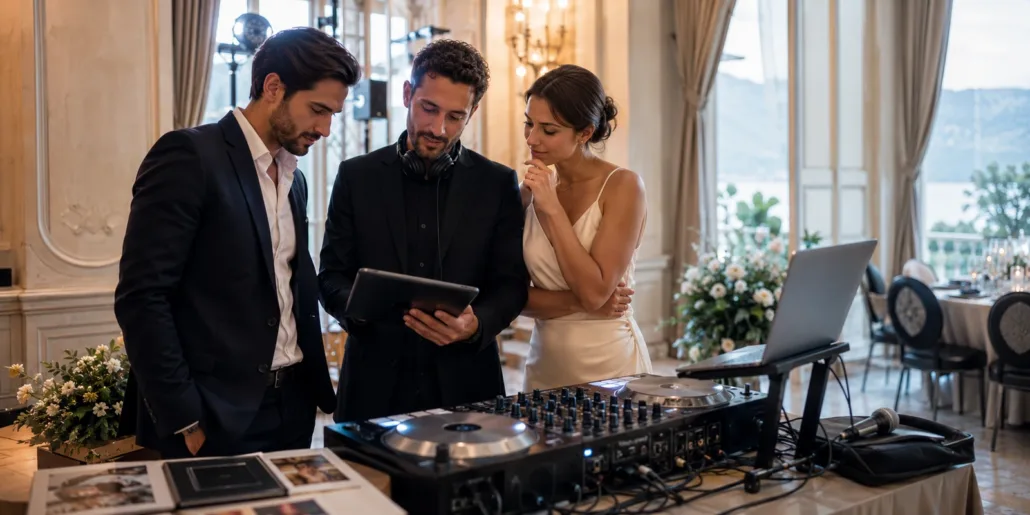
Understanding how to promote a DJ means showing what sort of party they can handle, not how many songs they have. Anyone organising a wedding or a private party wants to know how you’ll set the mood for the different parts of the evening, whether you’ll use the microphone, what kit you’ll bring and how you’ll tailor your set to the audience. A profile full of music genres, photos of the DJ booth and phrases like “I’ll get everyone dancing” leaves too many questions unanswered. To receive more suitable enquiries, describe your actual service: style, presentation, equipment, duration, limitations and your rapport with guests and the venue.
The customer isn’t buying a playlist, but the organisation of the party
A DJ’s work begins before the dancing starts. At a wedding, they may provide music as guests arrive, set the scene for the bride and groom’s entrance, oversee the first dance, coordinate with the cutting of the cake and help transition from dinner to the dance floor. At a private party, the programme is often less formal, but the audience can be very diverse.
Your profile should make it clear what kind of events you cover and in what capacity. There is a difference between a DJ set with no hosting, a gig with just a few pre-arranged announcements, and a full package including presentation, sound and lighting. If you use a microphone, explain how: some clients are looking for a low-key presence, whilst others prefer a more active hosting style.
A concrete description might say that you provide background music at a controlled volume, manage the agreed-upon segments and build up the dance set whilst taking into account the audience’s age, reactions and requests. This suggests a method. “Professional DJ for every occasion”, on the other hand, could describe anyone.
Genres and style: how to be specific without limiting yourself
“360-degree music” sounds reassuring, but it doesn’t help the client visualise the evening. It’s better to specify the main genres, the eras you know best and the structure of your sets. International pop, dance music from the 1980s to the present day, Italian hits and revival tracks already help to establish a clear identity.
Being recognisable doesn’t mean imposing a rigid set list. You can explain that you put the programme together with the bride and groom or the guest of honour, gathering their favourite tracks, essential moments and a short list of songs to avoid. You should also make it clear how you handle requests from guests: you can consider them depending on the stage of the evening, without interrupting the musical flow to accommodate every single one.
When putting together a wedding DJ profile, it’s best to distinguish between background music, scheduled segments and the dance floor. A repertoire suitable for dinner doesn’t automatically mean the DJ is capable of keeping the party going until the end. Similarly, a set recorded in a crowded nightclub doesn’t give a true picture of how the DJ performs at a reception with guests of different ages.
Video, control desk, lighting and the audience: what needs to be seen
A good DJ set video should show the setting, the audience and the transitions between tracks. Fast-paced shots of the decks, hands on the controls and the lights on may look good, but they don’t show whether you know how to get the dance floor going, keep it lively or react when the energy drops.
Choose a few clips showing different moments. One could show the start of the dancing, when the guests are still a bit hesitant; another could show the dance floor already full; a third could show a quieter moment, such as the aperitif. The audio should give a true sense of the atmosphere.
The equipment should also be presented from the client’s perspective. Specify whether you are bringing a mixing desk, sound system, microphone, dance floor lighting or ambient lighting. Equipment models are particularly relevant when they affect technical compatibility; more often than not, it is the overall dimensions, set-up time and visual impact that matter. A photograph showing the complete, well-organised set-up is worth more than many close-ups.
A range of packages for weddings, private parties and corporate events
DJ packages for events should offer genuinely different services. Simply changing the name and adding a few lights isn’t enough. A wedding may require a long set, multiple venues, a microphone and coordination with the photographer and venue manager. A private party may focus on just a few hours of dancing. A corporate event may involve unobtrusive music, strict timings and scheduled performances.
For each package, specify the duration, equipment included, arrival time, set-up, any assistant required, service limitations and conditions for extensions or travel to other venues. If the basic package includes a mixing desk and sound system but not lighting, state this clearly. If you will only use the venue’s sound system following a technical check, do not present this as a guaranteed solution.
Make sure you also highlight the difference between a DJ, a DJ who also hosts the event, and a full sound and lighting package. Many clients use the same term for different requirements; a clear structure helps avoid quotes based on expectations that only come to light too late.
SIAE, sound systems and venues: responding without causing any confusion
When it comes to matters relating to recorded music, it is best to be clear but cautious. If the service does not include handling the SIAE licence, state this clearly and ask the client to clarify who is responsible with the venue and the organiser, checking the latest guidance on the official SIAE website. Your experience may help you to raise the issue, but it does not automatically make you the person responsible for it.
Italian procedures do not apply to events held in Ticino or elsewhere in Switzerland. The client should consult the official SUISA guidelines and liaise with the host organisation or the relevant authorities.
The statement “the venue already has a sound system” also needs to be checked. Ask what speakers are available, where they are located, what connections they offer, who operates them and whether there are any volume restrictions. Finding out just before the party that the system is only intended for announcements could affect the set-up, the timetable and the quote.
How to create a distinctive DJ profile on Lyrium
Before updating your profile, please note the page dedicated to wedding DJs and ask yourself what concrete difference your proposal makes. The first few lines should outline the type of events, geographical area, musical style, key facilities and how the events will be run.
Include the languages you can use for your listings, especially if you work between Italy and Ticino or with international guests. Specify whether you prefer to keep a low profile, whether you’ll only be present at agreed times, or whether you also offer commentary over the microphone. These details are more useful than vague phrases such as “passion and experience”.
You can update your DJ profile by organising videos, packages, regions and equipment in a clear and organised manner. Once the profile is complete, Find the plan that best suits your visibility needs in relation to the enquiries you wish to receive, without relying solely on the display to convey what the texts and materials are already intended to demonstrate.